
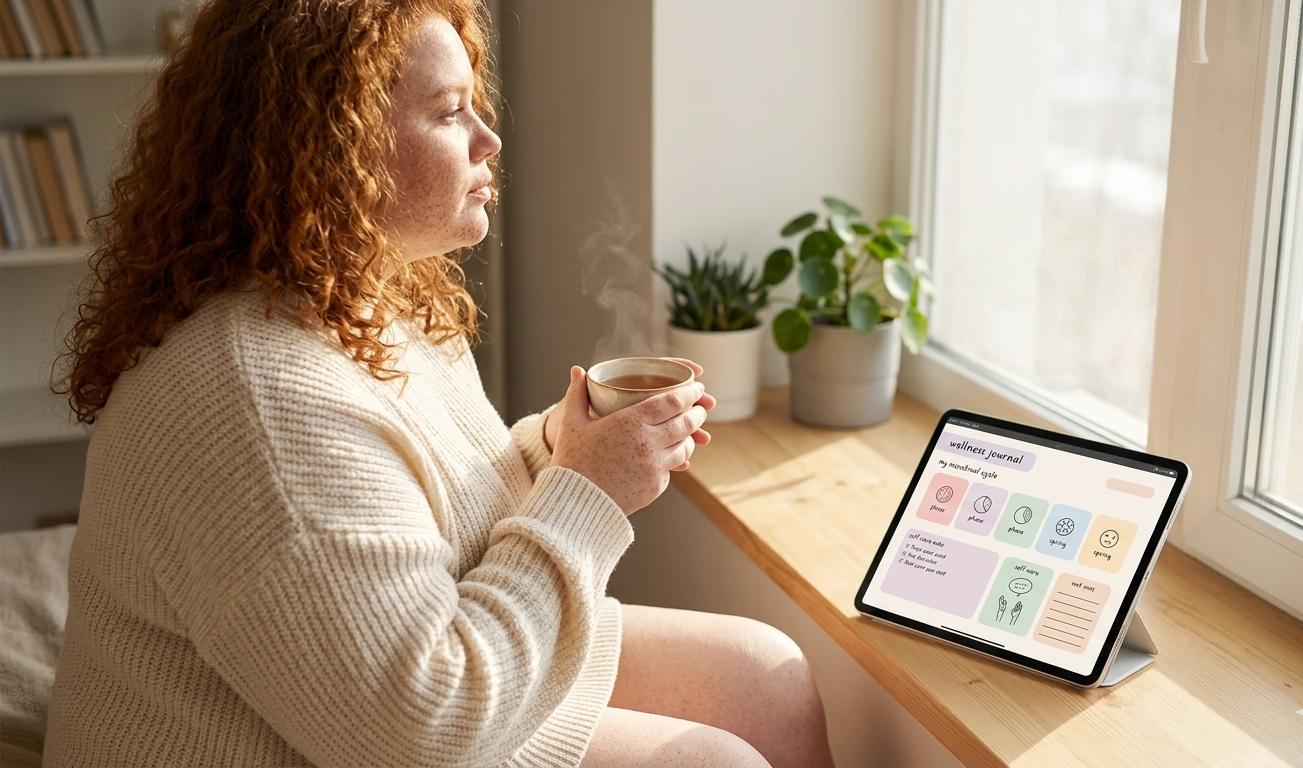
Your body is not a static thing. It moves through a beautiful, rhythmic cycle every month — and your skin moves right along with it. Estrogen rises and falls. Progesterone peaks and retreats. Testosterone surges at unexpected moments. Each of these shifts changes your skin's texture, its oil production, its sensitivity, its radiance.
Most of us fight this. We pile on the same products week after week and wonder why our skin feels uncooperative. But what if, instead of fighting it, you learned to flow with it? That is exactly what cycle syncing your skincare is about — tuning your routine to your body's internal clock so that every product you use is working with you, not against you.
Think of it as a form of soft productivity applied to beauty. Instead of a one-size-fits-all routine, you create a living, breathing practice that adapts to who you are each week. And when you track it — really notice the patterns — something quietly magical happens: you start to feel at home in your own skin.
The Four Phases of Your Skin's Year
Your menstrual cycle has four distinct phases, and I love to think of them as the four seasons. Each one brings a different hormonal landscape, a different emotional quality, and — yes — a different skin reality.
Estrogen and progesterone are at their lowest. Skin is dry, dull, and sensitive.
Estrogen rises steadily. Skin is plump, clear, and naturally luminous.
Estrogen peaks, testosterone rises. Skin glows — but sebum begins to increase.
Hormones drop sharply. Testosterone dominates. PMS breakouts and congestion appear.
Phase 1 — Winter: The Menstrual Phase (Days 1–5)
During your period, both estrogen and progesterone fall to their lowest point of the entire month. Your skin loses some of its natural moisture barrier, which makes it feel drier, more reactive, and stripped of its usual glow.
This is not the moment for exfoliation or strong actives. This is your skin's rest and restore season — and it deserves the same tenderness you would give yourself on a slow winter morning.
Your Winter Skincare Strategy
- Pause your acids and retinol — AHAs, BHAs, and vitamin A derivatives can be too stripping right now. Give your barrier a break.
- Layer hydration deeply — reach for hyaluronic acid to pull moisture in, followed by ceramide-rich creams to lock it there.
- Introduce centella asiatica (Cica) — this calming botanical reduces redness and supports your skin's repair process beautifully.
- Try a gentle jade roller massage — light facial massage encourages circulation and gives your skin a subtle natural flush without irritating it.
- Use a richer overnight mask — while you rest, let a deeply nourishing sleeping mask do the work of recovery.
Use your digital wellness journal to note how your skin feels on Day 1 versus Day 5. You will start to see your own personal patterns — which is exactly the kind of self-knowledge that transforms your routine.
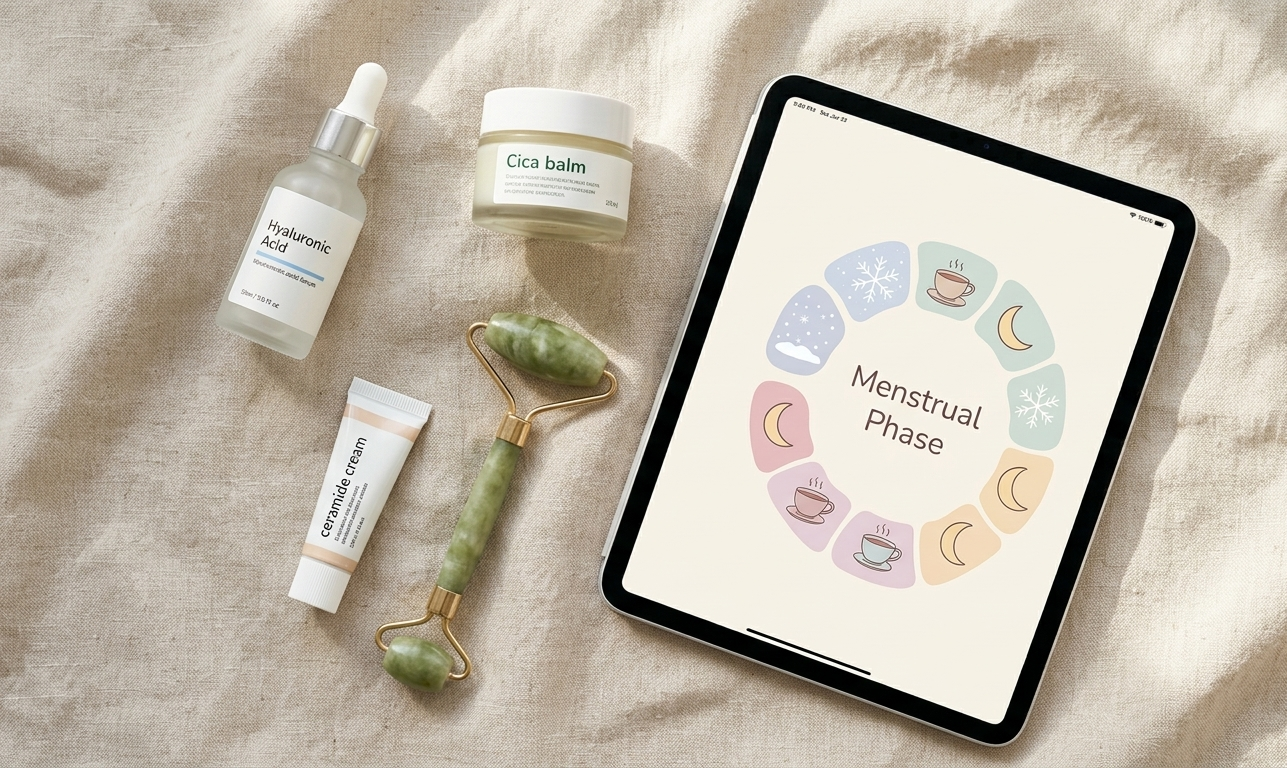
Winter phase essentials: hydration, barrier support, and rest.
Phase 2 — Spring: The Follicular Phase (Days 6–13)
As your period ends, estrogen begins its gentle, steady climb — and you will feel it. Your energy lifts. Your mood brightens. And your skin? It enters what I truly believe is its most cooperative, luminous state of the entire month.
The skin barrier is stronger, moisture levels are balanced, and cell turnover accelerates. This is the golden hour for your most active skincare ingredients.
Your Spring Skincare Strategy
- Reintroduce AHA exfoliation — a gentle glycolic or lactic acid exfoliant used 2–3 times this week will enhance cell renewal and amplify your natural glow.
- Layer on vitamin C — your skin absorbs actives more efficiently now. A brightening vitamin C serum applied in the morning will even tone and protect against oxidative stress.
- Lighten your moisturiser — your sebum production is balanced, so you can swap to a lighter gel-cream without sacrificing hydration.
- Book your treatments — if you visit a facialist or do at-home treatments like gua sha rituals or LED masks, the follicular phase is when your skin will respond best.
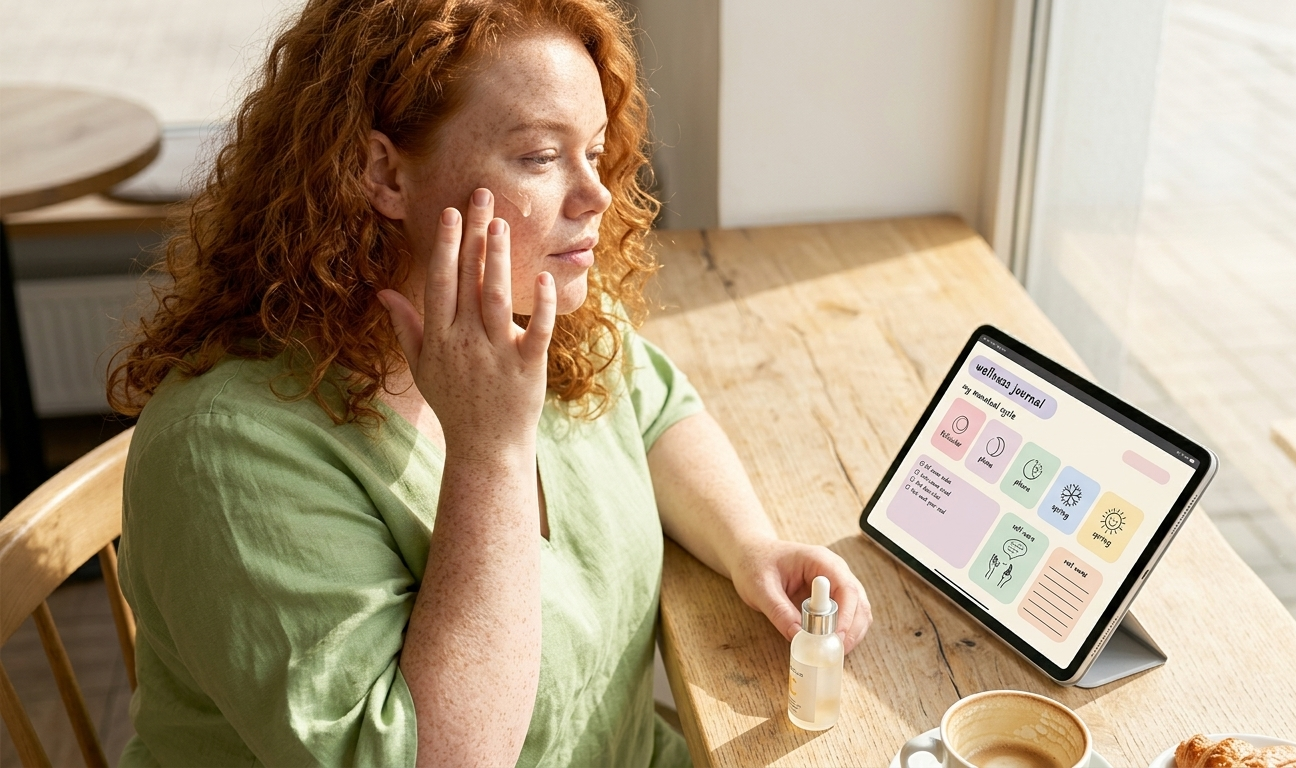
Spring phase: your skin's golden hour for actives and brightness.
Phase 3 — Summer: The Ovulation Phase (Days 14–17)
This is peak glow season. Estrogen reaches its highest point, and with it comes luminosity, plumpness, and the kind of skin that makes people ask what you have been doing. Enjoy every moment of it.
But here is what most women are not told: as ovulation begins, testosterone quietly starts to rise too. By the end of this window, sebum production increases — which can mean the first subtle signs of congestion if you are not paying attention.
Your Summer Skincare Strategy
- Switch to water-based or gel textures — lightweight hydration keeps your skin balanced without adding to the rising oil production.
- Introduce salicylic acid (BHA) — a BHA toner used in the second half of this week gently clears excess sebum from inside the pores before it can lead to breakouts.
- Keep SPF non-negotiable — your skin is naturally more exposed to UV sensitivity around ovulation. A mineral, lightweight SPF 50 is your best friend.
- Simplify, don't add — resist the urge to experiment with new products now. Your skin is thriving; let it.
Phase 4 — Autumn: The Luteal Phase (Days 18–28)
And then comes the shift that so many of us dread — the week before our period. Progesterone and estrogen both begin to fall. Testosterone becomes the dominant hormone. And the skin responds accordingly: pores appear larger, congestion builds, and for many women, PMS breakouts appear along the jawline and chin.
I want you to hear something important: this is not your skin failing you. This is your body doing exactly what it is designed to do. Your job is simply to support it, not fight it.
Your Autumn Skincare Strategy
- Use a gentle clay mask once or twice — a kaolin or bentonite clay mask draws out impurities without stripping the skin, and it feels deeply satisfying this week.
- Apply niacinamide morning and night — this gentle, anti-inflammatory ingredient regulates sebum, minimises the appearance of pores, and calms redness around emerging blemishes.
- Keep your hands away from your face — bacteria transfer is especially problematic when pores are dilated. This single habit makes a real difference.
- Avoid harsh scrubs or strong acids — inflammation is already elevated; adding more irritation will only worsen breakouts and sensitivity.
- Tend to your emotional skin — the luteal phase often brings heightened sensitivity emotionally too. A calming evening ritual — a face massage, a warm bath, quiet time with a digital journal — supports your nervous system, which in turn supports your skin.
Never squeeze or pick at PMS blemishes during this phase. Instead, apply a targeted niacinamide serum or a hydrocolloid patch and leave them completely undisturbed. Your skin will heal faster — and so will you.

Autumn phase: soothe, protect, and practice radical gentleness.
Your New Relationship with Your Skin
The Most Radical Skincare Practice Is Simply Listening
When you stop fighting your skin and start listening to it, something profound shifts. You begin to understand that every phase — even the difficult ones — is part of a cycle you can work with, not against. Your skin is not broken. It is beautifully, intelligently alive. And it has been trying to tell you what it needs all along.
Start small. Track one phase this month. Notice one pattern. Let that quiet awareness grow into a practice — and watch how deeply your relationship with your skin begins to change.
