

There is a particular kind of exhaustion that comes not from doing too much, but from carrying too much. It lives quietly in the background of your days — in the "if only I had…" that surfaces at 2 a.m., in the way you replay a conversation from three years ago and wince, in the hollow ache of wishing you could go back and be different.
I know that feeling. And I want to talk to you about it — gently, honestly, and without any judgment at all.
The Weight of "If Only" — And Why We Can't Let Go
The mind is wired to protect you. And one of the ways it tries to do that is by replaying your mistakes — as if going over them enough times might somehow undo them, or at least prevent you from repeating them. It is a survival mechanism. But somewhere along the way, that protective loop becomes a prison.
You start to identify with your mistakes instead of simply learning from them. The thing you did becomes who you are. And that is where guilt transforms into something far heavier: shame.
There is a difference between accountability and self-punishment. Accountability is a sign of growth. Self-flagellation is a sign that you have confused the two — and it is one of the most common traps I see women fall into.

Why Guilt Is Not Always the Enemy
Before we talk about letting go, I want to honour something: guilt, in its healthy form, is actually a beautiful signal. It means you have a conscience. It means you care about the impact you have on others. It means you hold yourself to a standard that matters to you.
That is not a flaw — that is integrity.
The problem is not feeling guilt. The problem is overstaying in it long past the point where it serves you. Once you have acknowledged the mistake, taken responsibility where possible, and made amends where you can — the guilt has done its job. Everything after that is suffering without purpose.
Ask yourself: Is what I am feeling right now helping me become better, or is it just hurting me? If the answer is the second one — it is time to thank the guilt for its message, and gently release it.
How to Actually Stop the Self-Flagellation
1. Separate Yourself from Your Actions
You are not your behaviour. You are the consciousness behind it — the one who is capable of witnessing, reflecting, and choosing differently next time. When you collapse the distance between "I did something hurtful" and "I am a hurtful person," you remove all possibility of growth. Because if you are fundamentally broken, why bother trying to change?
The practice is simple but profound: talk to yourself the way you would talk to someone you love. Would you tell your closest friend that she is irredeemable because of a mistake she made years ago? Of course not. You would remind her of everything she has overcome, everything she has become. You deserve that same grace.
2. Process It on the Page — Then Close the Tab
One of the most powerful tools I have found for releasing guilt is intentional journaling. Not the kind where you write the same painful story over and over — but the kind that moves you through it and out the other side.
Try this: write out exactly what happened, how it made you feel, what you wish you had done differently — and then write a letter of forgiveness to yourself. Read it back slowly. Let it land.
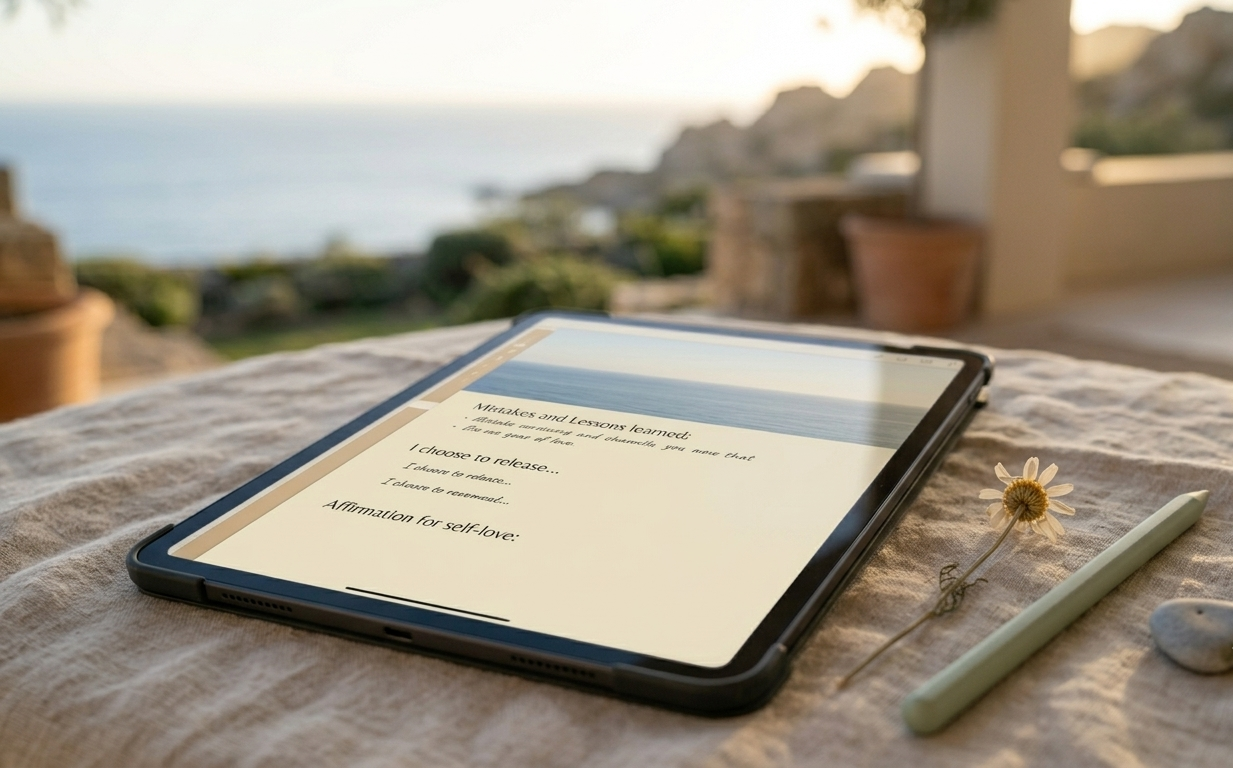
A dedicated self-reflection journal — one you return to with intention, not spiral into with dread — creates a container for your feelings. You give them a home on the page so they do not have to live in your body all day.
3. The Soft Productivity Approach to Inner Work
Healing does not have to look like a brutal excavation. It can be soft. Slow. Even quiet.
The Soft Productivity mindset that we talk about so much here at EaseOnMe applies to inner work just as much as it does to your career. You do not have to "fix yourself" in one intense session. You can give yourself ten minutes a morning, a gentle prompt, a kind word — and trust that consistency, not intensity, is what creates real change.
- Light a candle and sit quietly before you open your journal.
- Choose one thing you are releasing — not a whole list.
- End every session by writing one thing you appreciate about who you are today.
4. Embody the Woman You Are Now
The Magnetic Queen approach to self-love is not about pretending the past did not happen. It is about refusing to let it define your identity. The woman you were five years ago made the best decisions she could with the awareness, tools, and emotional capacity she had at the time. You have grown since then. That is the whole point.
Every morning, before you reach for your phone, ask yourself: Who am I choosing to be today? Not who you were. Not who you fear you are. Who you are choosing to become — right now, in this moment.

Embracing the Present: Your Past Made You, Not Broke You
Here is the truth that I want you to sit with for a moment: every hard chapter, every decision you wish you could undo, every moment you are still ashamed of — they are all part of the reason you are as layered, empathetic, and quietly powerful as you are today.
The woman who has never made a mistake has never taken a real risk. Has never loved deeply enough to get hurt. Has never grown past her own edges. That is not a woman you want to be — and I do not think you actually do.
Your past is not a sentence. It is a school. And you have been an extraordinary student.
A Gentle Invitation
The Past as a School, Not a Prison
Tonight, open a fresh page and write these words at the top: "I release what no longer serves me. I am not my mistakes — I am what I have built from them." Then write for ten minutes without stopping. See what comes. Whatever arrives, meet it with the same warmth you would offer your dearest friend. You have always deserved that kindness. It is never too late to begin giving it to yourself.
You are not behind. You are not broken. You are exactly where you need to be — and the woman who reads these words is already, quietly, choosing herself. That is enough. That has always been enough.
