
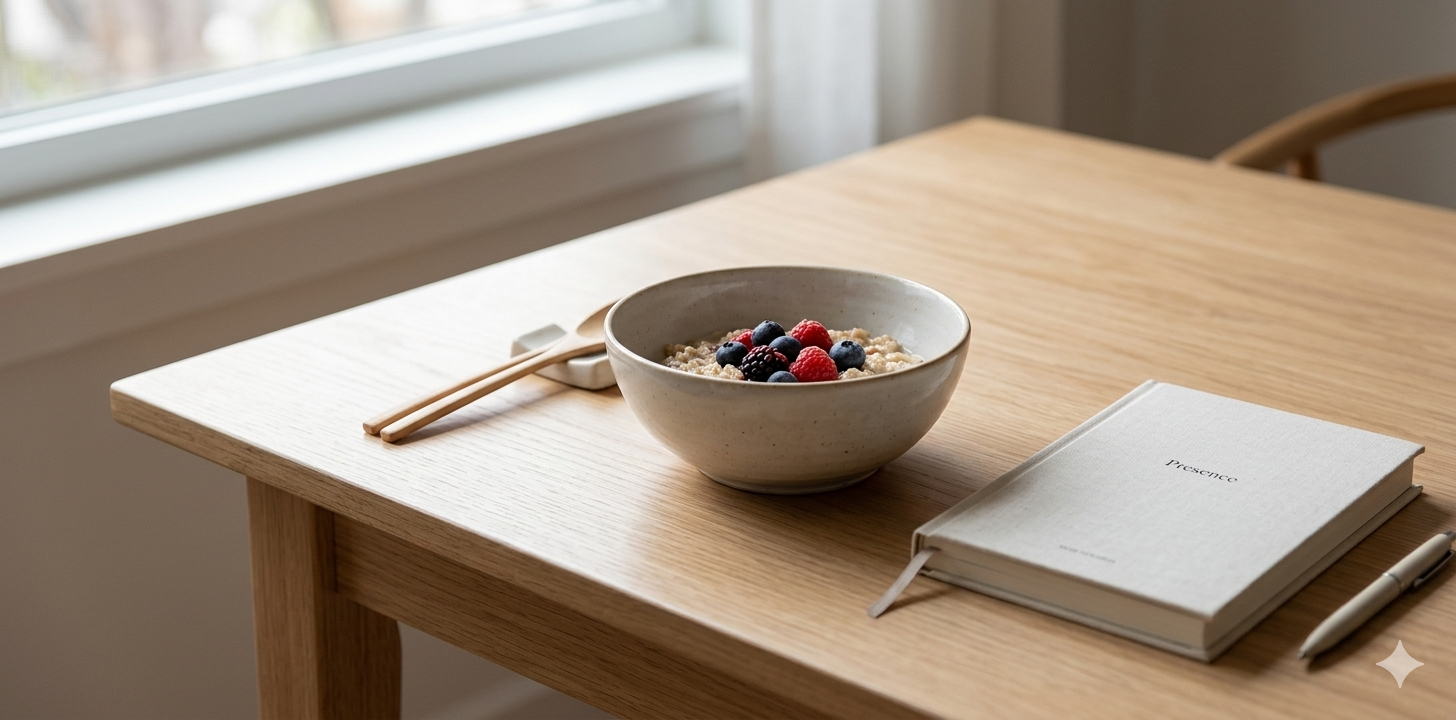
I want you to think about the last meal you had. Were you really there for it? Or were you scrolling, half-watching something, or running through your mental to-do list between bites? If you're anything like most of us, the answer is probably the latter.
We live in a world where eating has become something we do in the background — a task to check off, fueling ourselves between the "real" things. And yet, the way we eat is so deeply connected to how we feel, how we think, and how magnetic our energy truly is.
Why Diets Fail — and Why Presence Works
Traditional diets rely on external rules. Count this, restrict that, avoid the other thing. And while some structure can be helpful, this approach puts us constantly at war with our own desires — triggering stress, guilt cycles, and, ultimately, burnout.
Research on mindful eating points to something more sustainable: shifting the focus from what you eat to how and why you eat. It's an experience-based process rooted in awareness rather than control. The father of modern mindfulness, Jon Kabat-Zinn, defined mindfulness as paying attention on purpose, in the present moment, non-judgmentally. Applied to eating, this is genuinely transformative.
Mindful eating isn't a diet. It's an invitation to come home to yourself — one meal, one breath, one bite at a time.

Setting an intention before eating is one of the most powerful practices you can build into your day.
The 7 Core Attitudes of Mindful Eating
These aren't rules. They're inner shifts — gentle ways of relating to food, your body, and yourself that change everything over time.
- Non-judging. Notice the thoughts and feelings that arise around food without labeling them as "good" or "bad." You ate the chocolate. You don't need a verdict on top of it.
- Patience. Allow meals to unfold at their own pace. Rushing is a form of disconnection. Slow down, even if just by one extra minute.
- Beginner's Mind. Approach familiar foods with fresh curiosity — as if tasting them for the very first time. What textures do you notice? What flavors arrive first?
- Trust. Your body knows. It sends signals — hunger, fullness, satisfaction — that are worth listening to. Learning to trust those cues is one of the most radical acts of self-care.
- Non-striving. Release the pressure to eat perfectly or achieve an outcome from every meal. The joy is in the moment, not in what the meal "produces."
- Acceptance. Welcome your current relationship with food exactly as it is — not as you wish it were. Acceptance is always the first step toward gentle change.
- Letting Go. Release the food rules, the guilt from last week, and the unrealistic expectations you've been carrying. Every meal is a fresh start.

You can practice mindful eating with a single strawberry, a square of dark chocolate, or a small handful of raisins.
An Intentional Practice: The One-Raisin Exercise
This is one of the most beloved mindfulness exercises — and it works beautifully with a raisin, a strawberry, or even a single square of dark chocolate. Here's how to experience it fully:
Hold the piece of food in your palm and simply look at it. Notice its color, its shape, the way the light catches its surface. Treat it like something you've never seen before.
Roll it gently between your fingers. Notice its texture — is it smooth, rough, soft, firm? Bring it close and inhale slowly. What scents arrive? Where do you feel them in your body?
Rest it against your lips before placing it on your tongue. Notice the anticipation that arises. Does your mouth begin to respond? This is your body's innate intelligence at work.
Take one deliberate bite. Chew slowly, noticing each wave of flavor and sensation. When did the taste shift? When did it start to fade? Be present for the entire experience — all the way to the swallow.
That's it. One small piece of food, fully experienced. It sounds almost too simple — and yet, most of us have never truly tasted anything this way. This is the essence of mindful eating.

Tracking your hunger cues and meal intentions in a digital planner can deepen your mindful eating practice beautifully.
One Gentle Question Before You Open the Fridge
Here is the softest, most effective habit I can offer you: before you reach for food, pause and ask yourself — Am I physically hungry, or am I seeking comfort, distraction, or relief?
This isn't about restriction or shame. It's pure curiosity. The more you practice this one question, the more clearly you'll begin to hear the difference between your body's true hunger and your emotions reaching for a coping tool. Both are valid. But knowing which one is speaking changes everything.
Consider keeping a brief mindful eating journal in your digital planner — just a line or two after each meal. Note your hunger level before, your satisfaction after, and one thing you genuinely tasted. Over time, this builds an incredibly rich map of your relationship with food.
Your Daily Ritual Starts Here
Claim Your Peace at Every Meal
Put down your phone. Light a candle if you have one nearby. Sit with your food and let the simple act of eating become a ritual of coming home to yourself. You deserve meals that nourish not just your body, but your entire energy.
Mindful eating isn't about perfection — it's about presence. And every single meal is a new invitation to practice. Start with one. That's more than enough.
