
I know how it feels. The notifications start before you even sit up in bed. Your inbox fills while you brush your teeth. By 10 a.m., you are already behind, already overwhelmed, already bracing for the rest of the day. Modern life is relentless — and our bodies were simply not built for it.
We search for expensive solutions: wellness retreats, adaptogen blends, meditation apps with premium subscriptions. And while those things have their place, the most profound reset available to you requires only one thing — stepping outside and walking among green things for twenty minutes.
The Cortisol Drop: What Science Discovered in the Forest
Every notification you receive triggers a small stress response in your body. Your brain cannot tell the difference between a WhatsApp ping and a physical threat — it responds to both by releasing cortisol, your primary stress hormone. When those alerts come in constantly, your cortisol levels never fully recover. You live in a low-grade state of fight-or-flight, and over time, that takes a real toll on your body and mind.
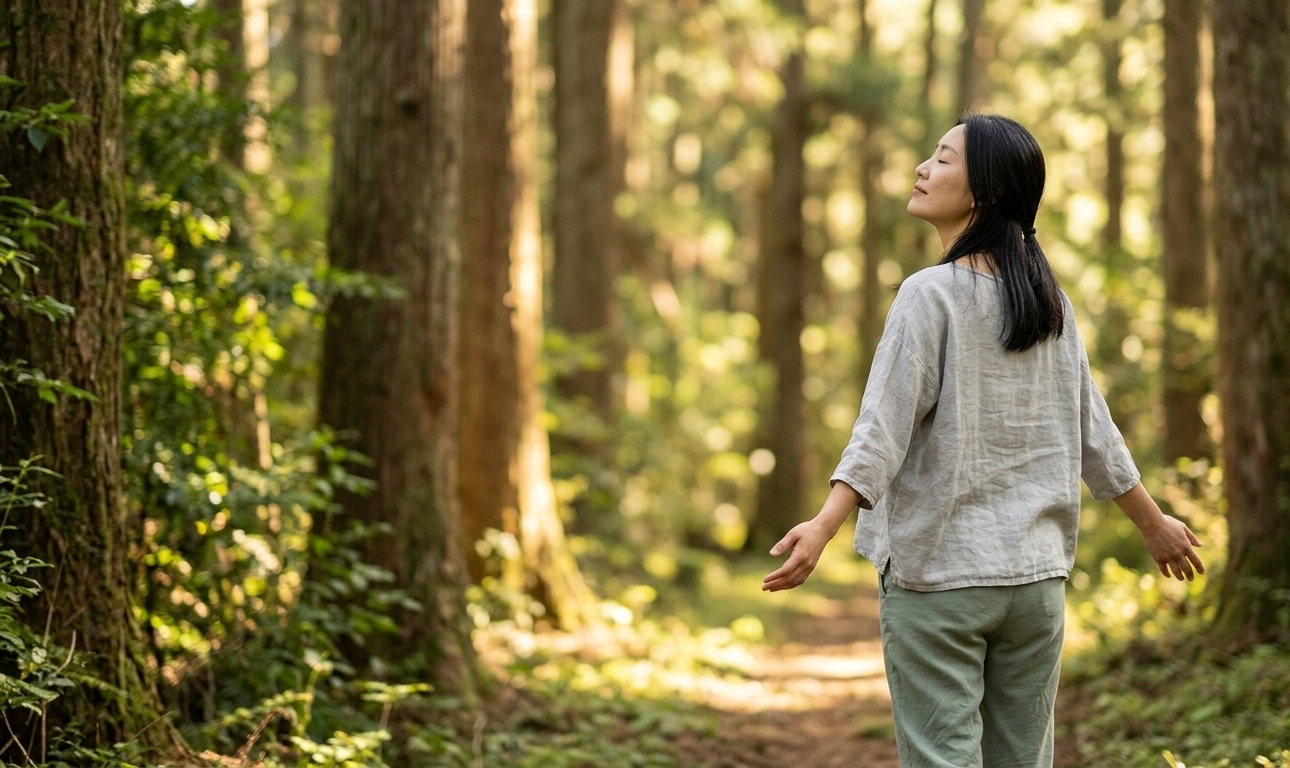
This is where the Japanese practice of Shinrin-yoku — or "forest bathing" — becomes extraordinary. Researchers at Nippon Medical School found that just 20 to 30 minutes walking in a natural green environment produces a measurable and significant drop in cortisol levels. Heart rate lowers. Blood pressure stabilises. The body, quite literally, exhales.
The Neurological Shift: From Survival Mode to Safety
Your nervous system operates on two primary settings. The sympathetic system — fight-or-flight — keeps you alert, reactive, and primed for threat. The parasympathetic system — rest-and-digest — is where healing, creativity, and genuine rest actually happen.
When you step into nature, your brain receives a cascade of sensory signals that it has been reading as "safety" for hundreds of thousands of years: the sound of wind in leaves, the smell of earth, the soft shifting of light through branches. These ancient cues tell your nervous system that you are not in danger. Without any effort on your part, the switch flips. You move from survival mode into restoration.
Studies show that even viewing natural scenes — trees, grass, open sky — lowers activity in the prefrontal cortex's rumination centre. Walking in nature quiets the mental loop of worry and self-criticism more effectively than an urban walk of the same duration.
The Secret Weapon: Phytoncides
There is something invisible happening when you walk through a forest, a park, or even a tree-lined street. Trees and plants continuously release airborne chemical compounds called phytoncides — their natural defence system against bacteria and insects. When you inhale them, something remarkable happens inside your body.
Research published in the International Journal of Immunopharmacology found that inhaling phytoncides significantly increases the activity of natural killer (NK) cells — the immune cells your body uses to fight inflammation, illness, and stress-induced damage. One two-hour walk in a forest can boost NK cell activity for up to seven days. You are not just calming your mind when you walk in nature. You are actively strengthening your immune system.
How Long Does It Take? A Simple Time Breakdown
The good news is that nature's healing effects are cumulative, and even a brief pause outdoors matters. Here is what the research tells us about time:
| Duration | What Happens in Your Body |
|---|---|
| 10 minutes | Instant mood lift. Mental fog begins to clear. Heart rate starts to drop. |
| 20–30 minutes | The optimal window for the sharpest cortisol reduction. Nervous system shifts into parasympathetic mode. Anxiety measurably decreases. |
| 120 minutes/week | The cumulative threshold linked to lasting well-being benefits — as identified by a landmark University of Exeter study of 20,000 people. |
Two hours a week. That is less than 18 minutes a day. You already have this time — it is simply a matter of choosing where to spend it.
How to Make Your Walk Actually Work: The Mindful Approach
A nature walk is not a workout. It is not an opportunity to catch up on a podcast or clear your inbox on the go. The moment you divide your attention, you lose most of the benefit. Here is how to walk in a way that truly resets you:
- Leave your phone in your pocket. No scrolling. No WhatsApp. No checking your steps. Let your attention rest on where you are, not where you need to be.
- Engage all five senses deliberately. Notice the sound of leaves underfoot. Feel the temperature of the air on your skin. Look up at the sky through the branches. Breathe in slowly and try to smell the earth, the grass, the green.
- Walk slowly and without destination urgency. This is not about burning calories or hitting a step count. It is about being, not accomplishing. Let your pace be gentle, your posture open.
- Let your gaze soften. Instead of focusing sharply on a fixed point, allow your eyes to rest in a soft, wide gaze — taking in the whole scene rather than any single detail. This activates a more meditative state in the brain.
- Release the agenda. You do not need to "solve" anything on this walk. The point is precisely to stop solving, even for twenty minutes.
Your invitation
Step Outside. Let Nature Heal.
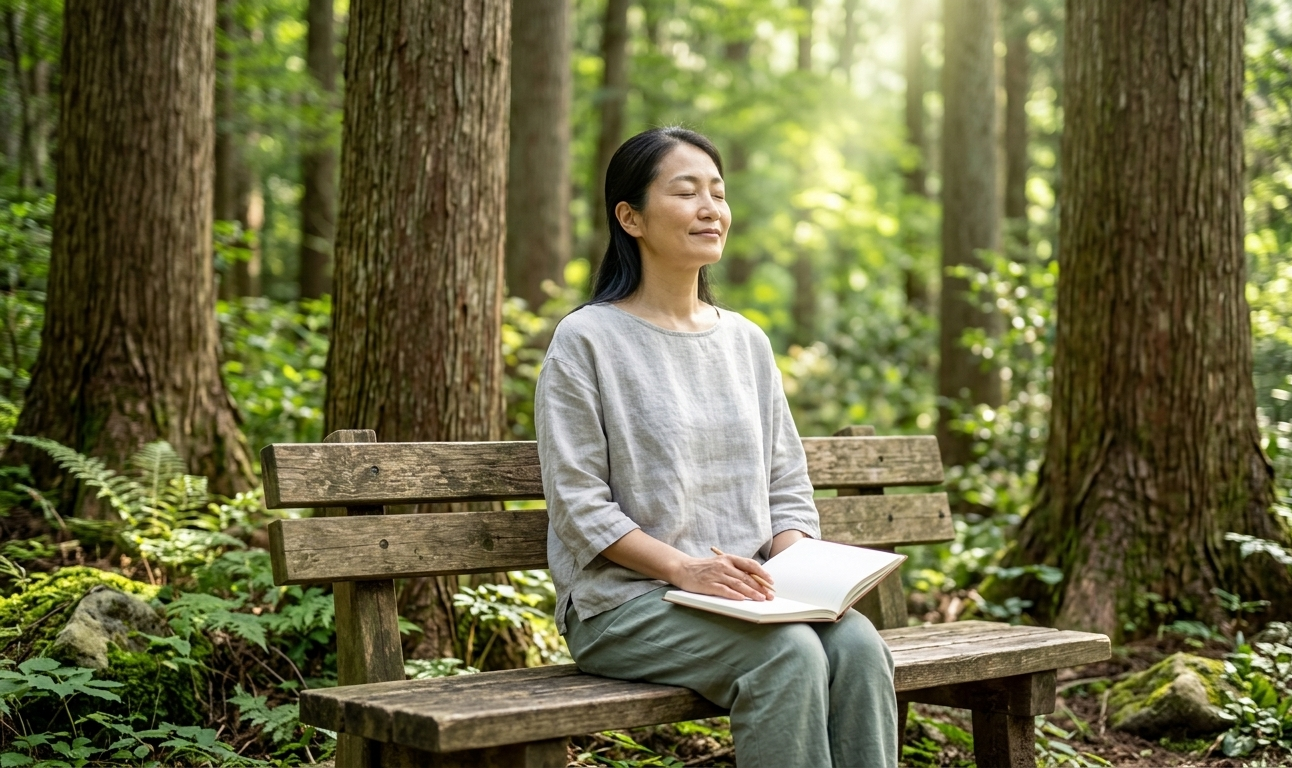
A walk in nature is not a luxury you earn after your to-do list is done. It is a biological necessity — as essential as sleep, as nourishing as food. Your nervous system was built for green spaces. Your immune system responds to the trees. Your mind needs the silence that only open air can offer. You do not need a trail, a forest, or perfect weather. You need twenty minutes, a patch of green, and the willingness to arrive.
Today, before the day decides itself for you — step outside. Not to think. Not to plan. Just to walk, breathe, and remember that you are a part of something far larger and calmer than your inbox.
