
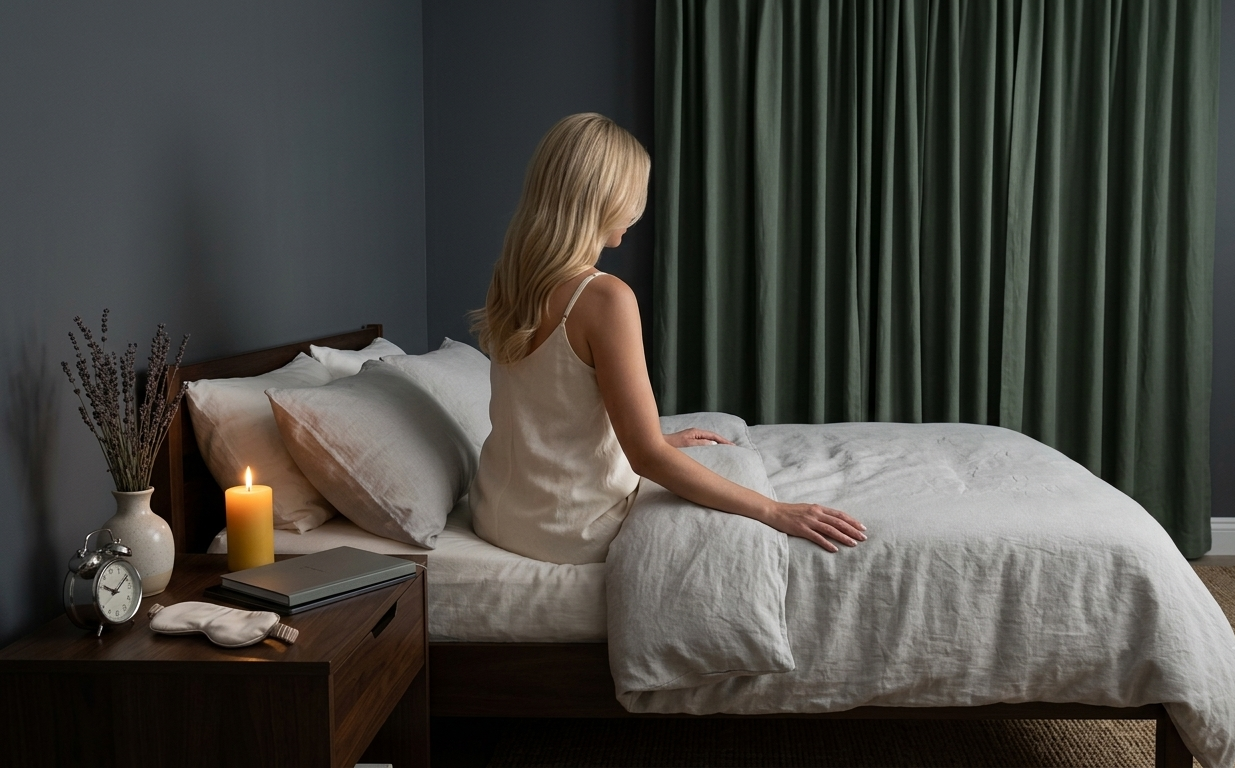
I want to ask you something honestly: when did you last wake up feeling genuinely restored? Not just functional — but deeply, quietly renewed, the way your body always intended sleep to feel.
If that feeling seems like a distant memory, you are not alone. So many of us lie awake long after our heads hit the pillow, scrolling, overthinking, tossing through a haze of shallow sleep. And most of us assume this is simply who we are now. But here is what I have come to believe: the problem is rarely you. It is your environment.
Sleep hygiene is not about a rigid bedtime routine. It is about designing a space that speaks directly to your nervous system — one that signals safety, stillness, and surrender the moment you walk through the door. Your bedroom is either working for your rest or quietly against it. Let us change that.
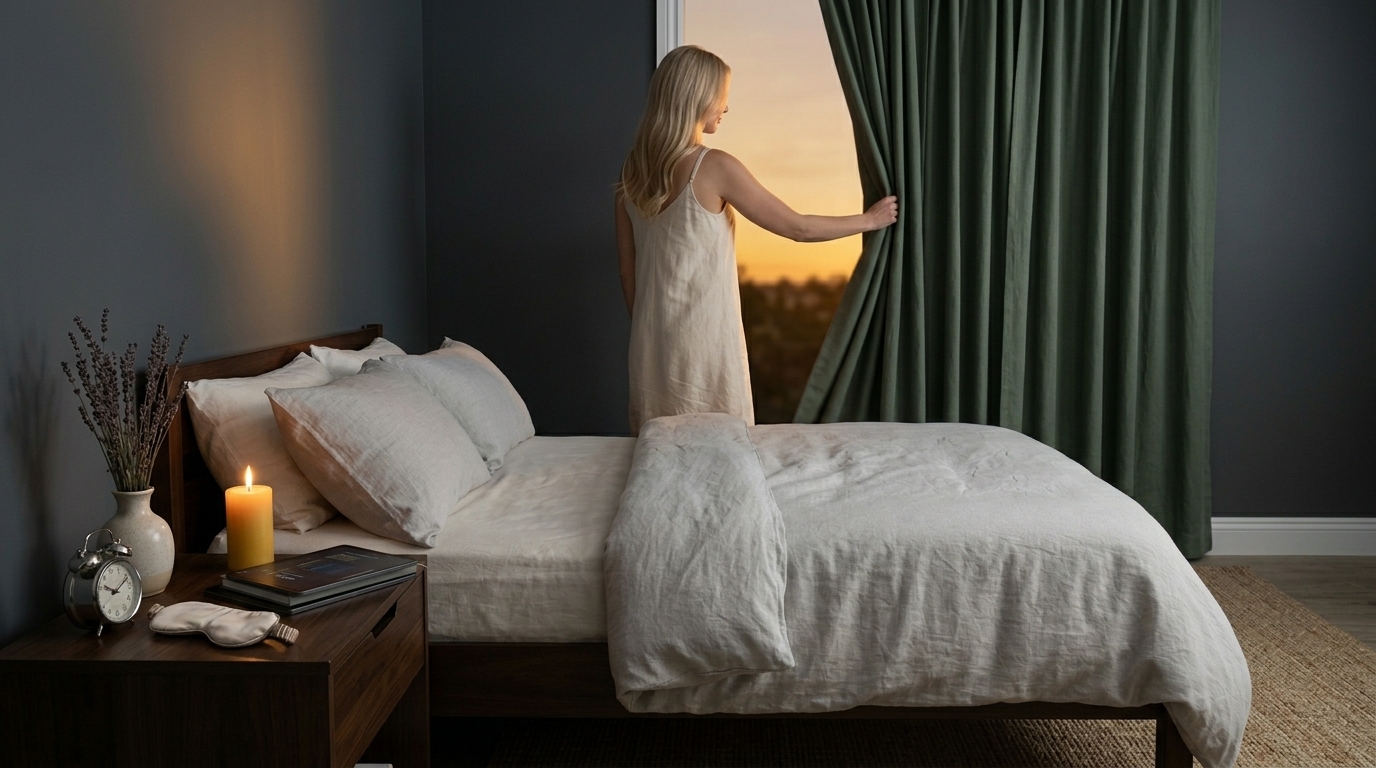
1. Total Darkness: The Law of Absolute Blackout
Your body produces melatonin — the hormone that pulls you into deep, restorative sleep — only in true darkness. Even the faint glow of a charging light or a streetlamp bleeding through your curtains is enough to disrupt this process. Light at night tells your brain: it is not time yet.
The solution is deliberate and beautiful. Invest in blackout curtains — linen or velvet in a tone that calms you. Cover every LED light in your room with a small strip of black tape. Remove or turn away any device with a glowing screen. And on nights when total darkness feels out of reach, a simple silk sleep mask becomes an act of self-care in itself.
Cover or remove just one source of artificial light in your bedroom tonight. Notice whether the quality of your sleep shifts.
2. Cool It Down: The Optimal Temperature for Deep Sleep
Here is something your body already knows: as you drift toward sleep, your core temperature naturally drops. Your bedroom needs to support that process — not fight it. Research consistently points to 18–22°C (65–72°F) as the sweet spot for deep, uninterrupted rest.
A room that is too warm keeps you in lighter sleep stages, leaving you groggy and unrested by morning. If you cannot control your thermostat precisely, the quality of your bedding matters enormously. Choose breathable, natural fibres — linen sheets that soften with every wash, or cotton so fine it almost disappears against your skin. These are not indulgences. They are investments in the one-third of your life you spend restoring yourself.

3. Create a Digital-Free Sanctuary
This one is difficult, and I say that without judgment. Our phones have become the first thing we reach for in the morning and the last thing we hold at night. But the blue light they emit suppresses melatonin production directly, and the content they deliver — news, messages, comparisons, endless scrolling — activates your stress response at exactly the moment your body needs to deactivate it.
The practice I recommend is gentle but firm: keep your phone outside the bedroom, or at the very least across the room and face-down. Replace it with an analogue alarm clock — a small, quiet one that does its one job beautifully. Replace the late-night scroll with something that feeds your soul instead: a few pages of a book, a few lines written in a journal, a few breaths taken in the dark.
Instead of scrolling before bed, spend five minutes writing tomorrow's intentions in your digital planner or a paper journal. You close the day intentionally, and you open the next one with clarity already waiting.
4. Master the Acoustic Environment
Sound is one of the most underestimated disruptors of sleep quality. It is not necessarily loud noise that causes the problem — it is sudden, unpredictable noise. A car alarm, a door closing, a notification ping: each one triggers a micro-awakening that pulls you from deep sleep stages, often without you ever becoming fully conscious of it. By morning, you have slept for seven hours and still feel like you barely rested.
The solution is acoustic consistency. A quiet fan or a white noise machine creates a steady sound layer that masks those sudden intrusions, keeping your nervous system undisturbed. Some people prefer the opposite approach: quality earplugs that create a soft silence. Find what works for your particular environment and make it non-negotiable.

5. Align the Senses: Minimalism & Aromatherapy
Visual clutter is a form of mental noise. When your eyes scan a bedroom filled with piles of clothes, half-unpacked bags, and surfaces covered in things that belong elsewhere, your brain registers disorder — and disorder signals that something still needs to be done. Cortisol quietly rises. Rest quietly recedes.
You do not need a perfectly styled room. You need a room that feels complete. Clear the surfaces of anything that does not serve rest. Keep a small bowl of lavender buds on the nightstand or diffuse a few drops of lavender essential oil in the hour before sleep. Lavender has a well-documented calming effect on the parasympathetic nervous system — the branch of your nervous system responsible for rest, digestion, and recovery. This is not folklore. This is your body responding to a signal it understands.
Before bed, spend two minutes tidying one surface in your bedroom. Then light a candle or diffuse lavender. Let these small acts be a signal to your nervous system that the day is complete.
Your Rest Ritual
Deep Sleep Is Not a Reward. It Is a Foundation.
You do not have to overhaul your bedroom tonight. You simply have to begin. Choose one shift — the curtains, the temperature, the phone, the sound, the scent — and commit to it for one week. Notice what changes in the quality of your mornings. Notice what becomes possible when you are truly rested. Your bedroom should be the most intentional room in your home, because everything you want to build — the clarity, the energy, the presence — begins with how well you sleep.
Tonight, give yourself permission to rest on purpose. You have earned every quiet hour of it.
